




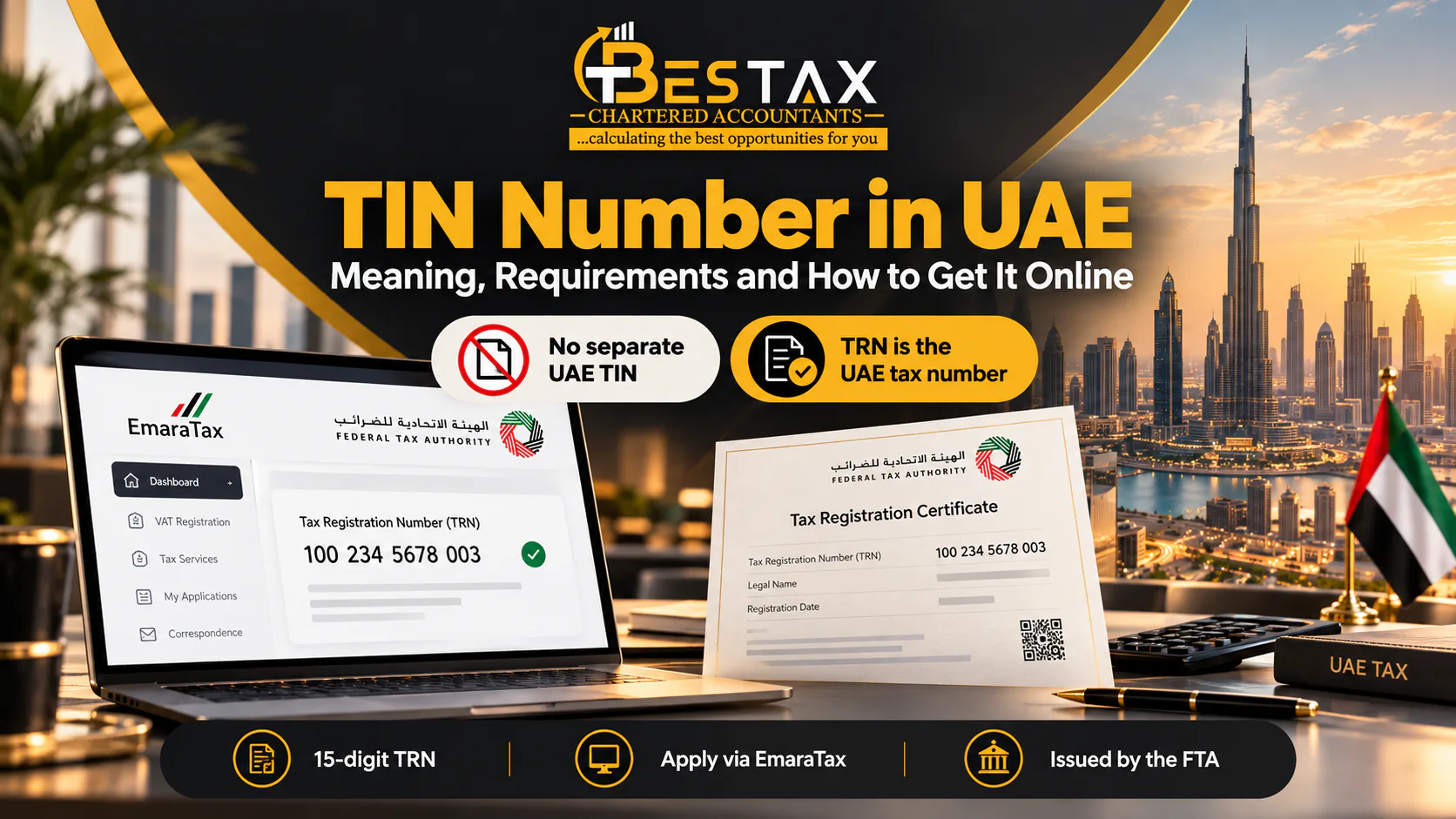
The UAE does not issue a separate Tax Identification Number (TIN). The number that works as your tax identification number in the UAE is the tax registration number the Federal Tax Authority (FTA) gives you when you register for VAT or corporate tax, and you apply for it online through the FTA EmaraTax portal.
This guide explains, in plain language, what a TIN number in the UAE actually means, who needs one, and how to get your tax number online step by step. No prior tax knowledge needed.
What Is a Tax Identification Number?
A tax identification number, sometimes called a taxpayer identification number, is a unique code a government uses to identify a taxpayer and link that person to their tax records, returns and payments. It is how a tax authority knows who you are.
Different countries use different names for it. The United States uses a Social Security Number or an Individual Taxpayer Identification Number, the United Kingdom uses a Unique Taxpayer Reference, and India uses a PAN. In the UAE, the equivalent number is the Tax Registration Number, or TRN.
So when a foreign bank, an investment platform or an international form asks for your “TIN,” in the UAE they are almost always asking for your TRN.
Does the UAE Issue a TIN Number?
No, not as a standalone number. As of the OECD’s January 2021 jurisdiction sheet for the UAE, the UAE does not issue Tax Identification Numbers, and TINs are not automatically issued to individuals or entities. That sheet pre-dates UAE corporate tax. Since June 2023, businesses and qualifying natural persons who register for corporate tax receive an FTA registration number that fills the TIN role, alongside the VAT TRN.
The UAE also issues Tax Residency Certificates on request. These are valid for one year and do not carry a TIN.
So there is still no standalone personal TIN in the UAE. What the country uses instead is the FTA registration number, which does the same job of identifying a taxpayer.
The TRN: Your UAE Tax Number in Practice
The Tax Registration Number is a 15 digit number issued by the FTA once your VAT registration is approved. It is the UAE tax number that appears on your tax invoices, your VAT returns and your correspondence with the FTA.
Here is what you should know about it:
- Format. A VAT TRN is a 15 digit code. In practice, VAT TRNs begin with 100, for example 100XXXXXXXXXXXX. This prefix is observed practice, not a rule set out in UAE tax law.
- Two different numbers. VAT registration gives you a TRN. Corporate tax registration gives you a separate Corporate Tax Registration Number. Both are issued by the FTA through EmaraTax.
- VAT power. Only a business with a valid TRN can legally charge VAT in the UAE.
- Not your licence. Your trade licence number is issued by your licensing authority. Your TRN is issued by the FTA. They are different numbers for different purposes.
On some international forms the TRN is described as a UAE tax identification number or a UAE taxpayer identification number, but it is the same number either way. There is no separate TIN ID card in the UAE. Your registration number, printed on your FTA certificate, is the identifier.
Do UAE Residents and Individuals Have a TIN Number?
Most individuals in the UAE do not have a TIN or a TRN, and that is completely normal. The UAE has no personal income tax, so a salaried resident is not given a tax identification number for UAE residents at all.
You only receive a tax number as an individual when you run a business. There are two situations that create one:
- VAT registration. Registration is mandatory once your taxable supplies and imports pass the VAT registration threshold of AED 375,000 in the past 12 months, or are expected to pass it in the next 30 days. You can register voluntarily from AED 187,500 (Federal Tax Authority).
- Corporate tax registration. Registration is required once your business turnover as a freelancer or sole establishment passes AED 1,000,000 in a calendar year (Cabinet Decision No. 49 of 2023). The FTA requires natural persons to register by 31 March of the following calendar year, and late registration carries an AED 10,000 administrative penalty.
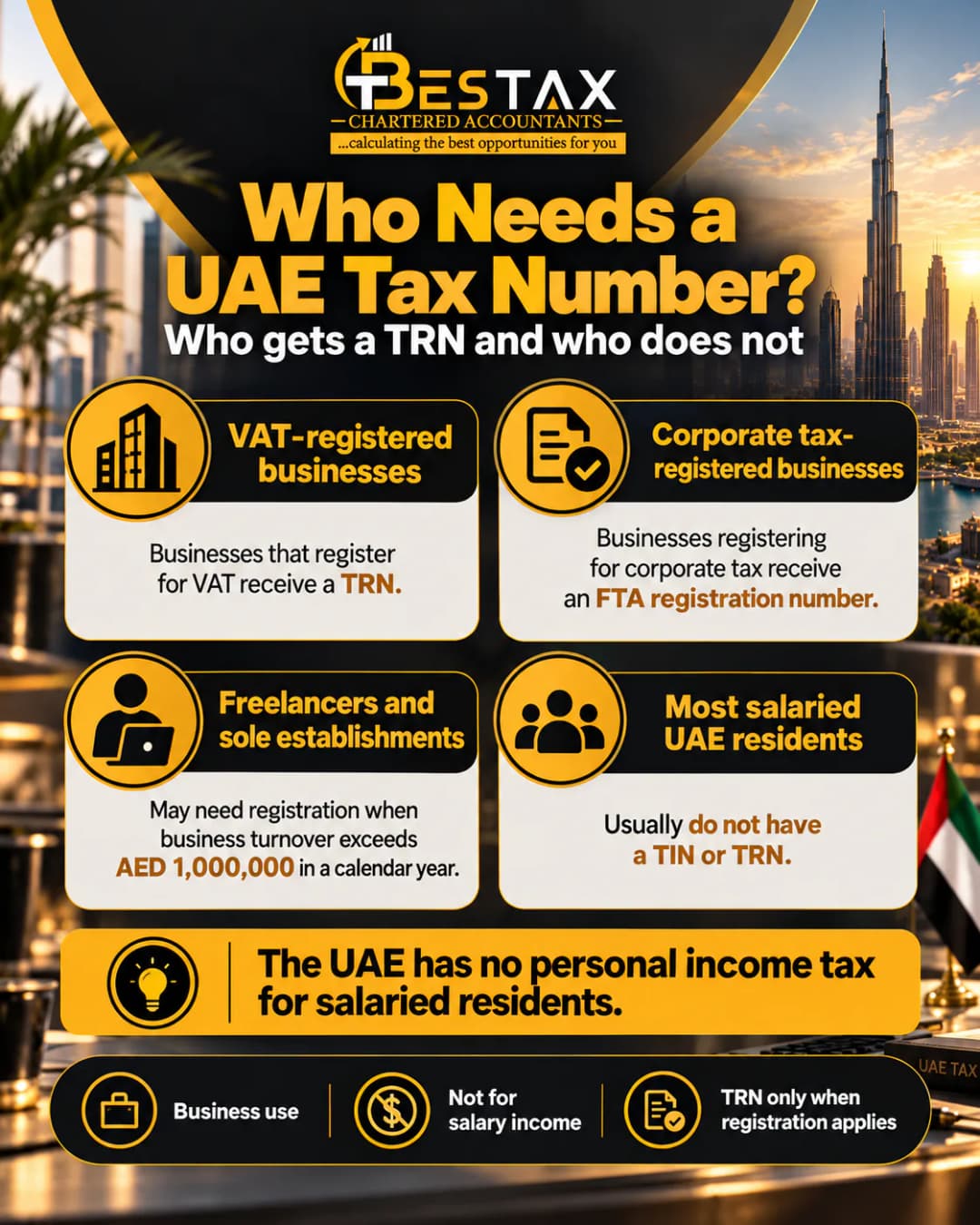
Salary, personal investment income and personal property income do not count toward that AED 1,000,000 and do not create a tax number. If neither situation applies to you, there is no UAE TIN number for individuals to obtain.
Why Banks and International Forms Ask for Your TIN
Banks ask for a “TIN” because of global information sharing rules. Under international standards for the automatic exchange of financial account information, UAE banks must record the tax residency of their account holders and report it. On these forms, the field is labelled Tax Identification Number (TIN).
What to enter depends on who you are:
- A UAE business enters its TRN in the bank TIN number field.
- A UAE resident individual with no tax number follows the form’s instructions for people whose country does not issue a TIN, which usually means selecting that specific option on the form.
How to Get Your Tax Number Online
You apply for tax identification in the UAE, in the form of a TRN, through the FTA EmaraTax portal. Here is how to get a TIN number online:
- Create an EmaraTax account. Go to the FTA website, sign up with your email, and verify it.
- Add your taxable person profile. Enter your business or personal trade details in the profile.
- Choose your registration. Select VAT or corporate tax, whichever applies to you.
- Complete the application. Fill in your activity, turnover and bank details.
- Upload your documents. Typically your trade licence, the owner’s Emirates ID and passport, and proof of turnover such as bank statements.
- Submit and wait for approval. The FTA reviews your application and issues your registration number. The FTA publishes a processing time of 20 business days from receipt of a complete application, for both VAT and corporate tax registration. It can take longer if the FTA asks for more information.
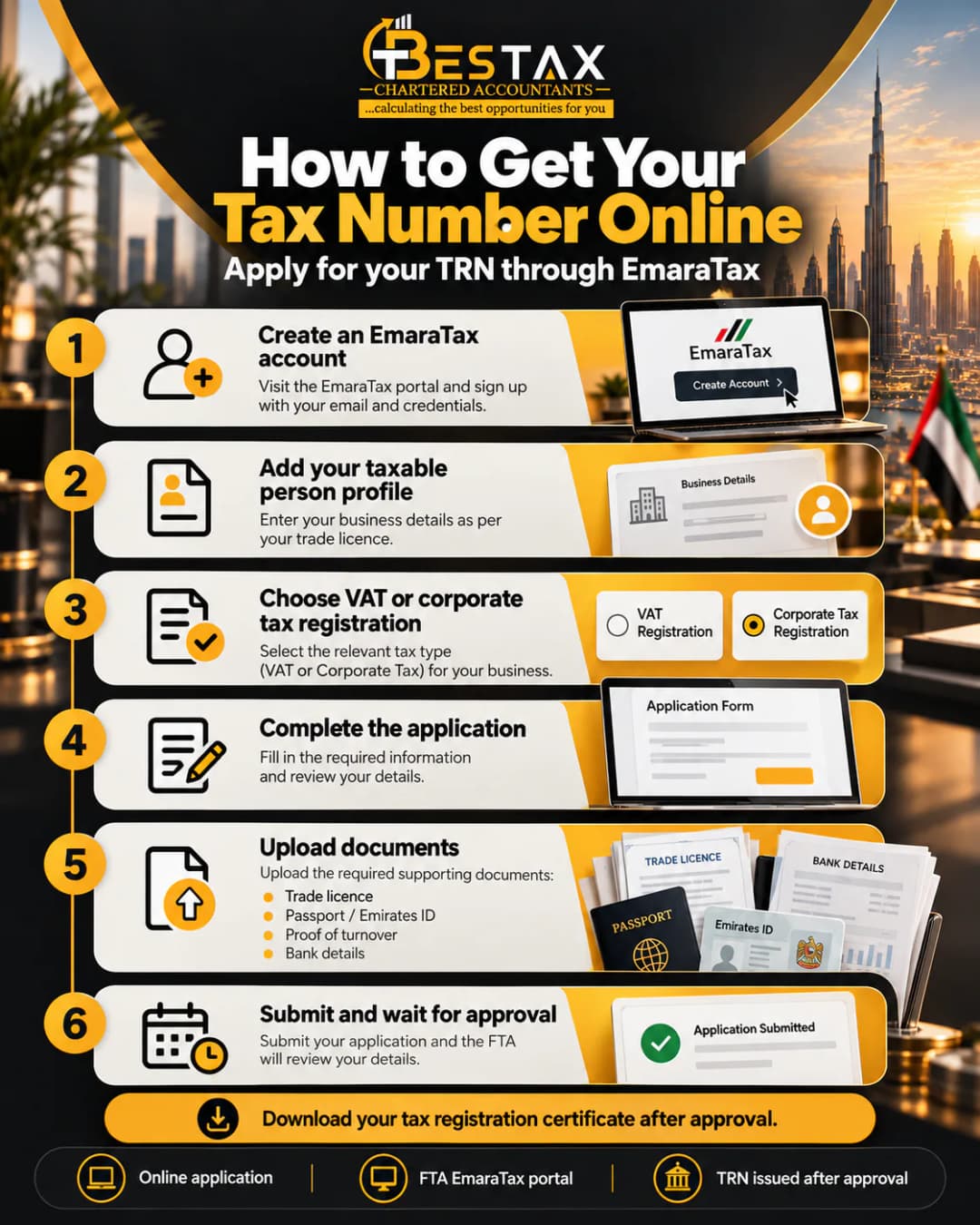
Once approved, you download your certificate showing your registration number from your EmaraTax account. This is the same process whether you apply for a tax identification number for VAT or you register for corporate tax. For the corporate side, our corporate tax registration service covers the documents and deadlines, and our team can handle your VAT registration from start to finish.
The Documents You Usually Need
The exact list depends on your business, but most applications need the following. For VAT, see our full list of documents required for VAT registration in the UAE.
- Valid trade licence
- Passport and Emirates ID of the owner or authorised signatory
- Contact and bank account details of the business
- Proof of turnover, such as recent financial statements or bank statements
Where to Find and How to Verify Your TIN
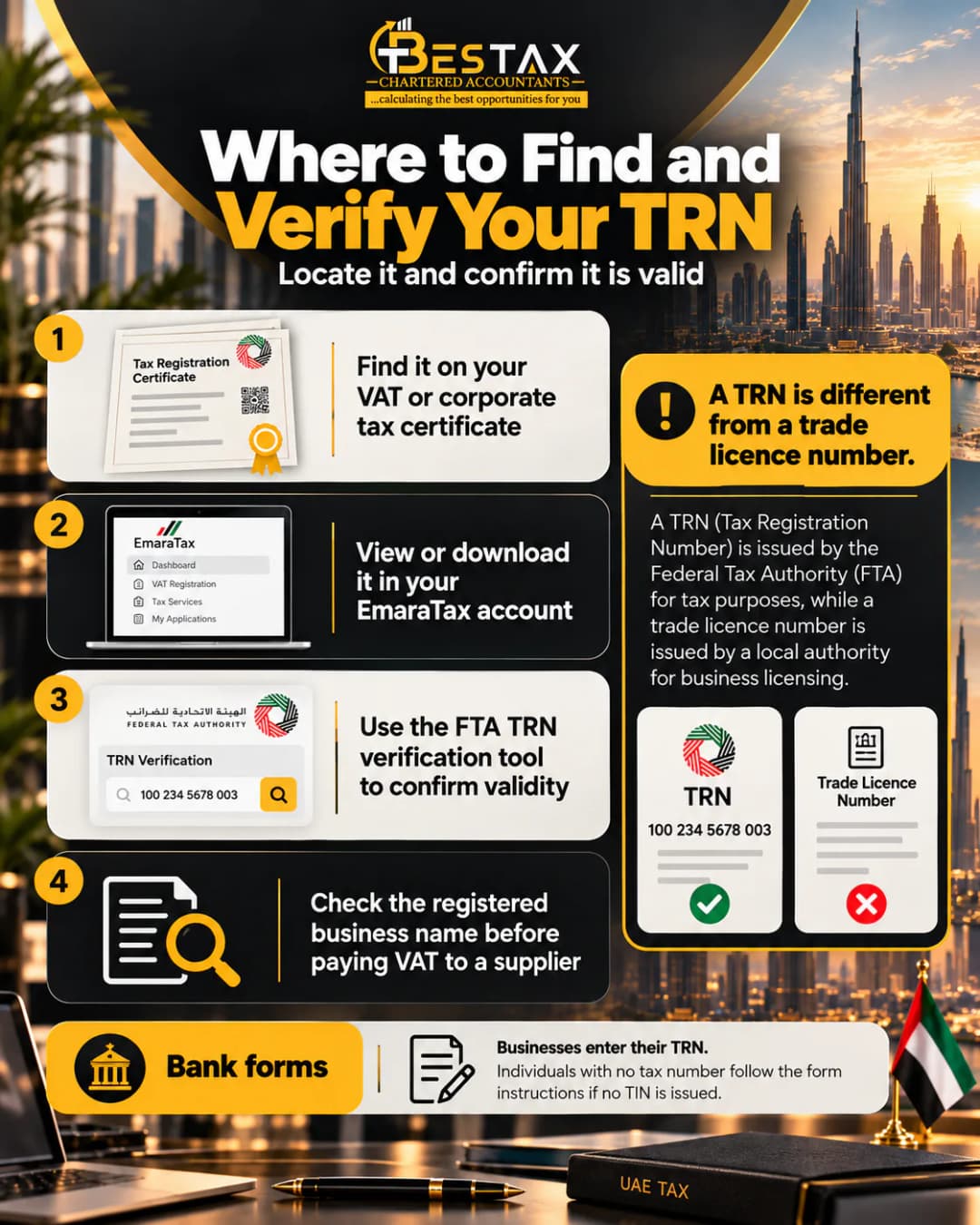
Your TRN is printed on your VAT registration certificate or your corporate tax registration certificate inside your EmaraTax account. If you cannot find it, log in to EmaraTax and open your taxable person profile to view or download the certificate.
To confirm that a number is genuine, use the FTA TRN verification tool, which shows whether a TRN is valid and the name of the registered business. Our guide on how to check TRN verification in Dubai walks you through it, which is useful before you pay VAT to any supplier.
Get Your UAE Tax Number the Right Way
Registering with the FTA is straightforward when your documents are correct, and costly when they are not. A rejected application means delays, and missing a registration deadline means penalties: a natural person who registers late for corporate tax faces an AED 10,000 administrative penalty.
Bestax is an FTA registered tax agency (Tax Agency Approval Number 30008692, Tax Agent Number 20052643) with more than 10 years in the UAE, 35+ professionals and over 10,000 clients served, rated 4.8 out of 5 across 290+ Google reviews. We complete your VAT and corporate tax registration on EmaraTax for you, so your TRN is issued without the back and forth.
Book a free consultation with our tax team.
Office 601, Damac Executive Bay Tower B, Al A’amal Street, Business Bay, Dubai | +971 56 798 1808 | info@bestaxca.com | Monday to Saturday, 9am to 8pm
Frequently Asked Questions
What is a TIN number in the UAE?
A TIN number in the UAE is your tax registration number from the Federal Tax Authority. The UAE does not issue a separate TIN, so the TRN you receive after VAT registration, or the Corporate Tax Registration Number you receive after corporate tax registration, is the number that identifies you for tax.
What is a tax identification number?
A tax identification number is a unique code a tax authority uses to identify a taxpayer. It links your tax returns, payments and records to you. In the UAE, this role is filled by the TRN.
How do I get a TIN number in the UAE?
To get a TIN number in the UAE, register your business for VAT or corporate tax on the FTA EmaraTax portal. Once the FTA approves your application, it issues your tax registration number, which acts as your tax number. There is no separate TIN to apply for.
How can I get a TIN number online?
You get a TIN number online through the FTA EmaraTax portal. Create an account, add your taxable person profile, complete the registration, upload your documents and submit. The FTA then issues your registration number, which you download from your account.
How do I apply for a TIN number?
You apply for a tax identification number by submitting a VAT or corporate tax registration on EmaraTax. The tax registration itself produces your number, so there is no standalone TIN application in the UAE.
How long does it take to get a TRN in the UAE?
The FTA publishes a processing time of 20 business days from receipt of a complete application, for both VAT and corporate tax registration. It can take longer if the FTA asks for more information or documents.
Do UAE residents have a TIN number?
Most UAE residents do not have a TIN number. The UAE has no personal income tax, so a salaried resident is not issued a tax number. You only receive one if you run a business that must register for VAT or corporate tax.
Do individuals in the UAE get a TIN?
Individuals get a UAE tax number only when they carry on a business. There is no personal Individual Taxpayer Identification Number in the UAE. A freelancer or sole establishment must register for corporate tax once turnover passes AED 1,000,000 in a calendar year, and for VAT once taxable supplies and imports pass AED 375,000.
Where can I find my UAE TIN number?
You can find your UAE TIN number on your VAT or corporate tax registration certificate. Log in to your EmaraTax account and open your taxable person profile to view or download it.
What should I enter as my TIN on a bank form?
If your bank asks for a TIN and you have a business tax registration, enter your TRN in the bank TIN number field. If you are an individual with no tax number, select the option on the form that your country does not issue a TIN.
What does a UAE tax number look like?
A UAE VAT TRN is a 15 digit code, and in practice it begins with 100, for example 100XXXXXXXXXXXX. Corporate tax registration produces a separate Corporate Tax Registration Number. Both appear on your FTA certificates, and there is no separate TIN card in the UAE.
Is a TRN the same as a TIN?
For practical purposes, yes. The UAE issues a TRN, and international forms call it a TIN. They point to the same Federal Tax Authority number.
Is a Tax Residency Certificate a TIN?
No. A UAE Tax Residency Certificate proves where you are tax resident for treaty purposes and is valid for one year, but it does not carry a TIN. It is a different document from your TRN.
References
- UAE Cabinet. (2023). Cabinet Decision No. 49 of 2023 on the taxation of natural persons under the Corporate Tax Law. Hosted on the Federal Tax Authority website. tax.gov.ae
- Federal Tax Authority. (n.d.). Registration for VAT. tax.gov.ae
- Ministry of Finance. (2022). Ministry of Finance confirms applicable taxable income threshold for corporate tax. mof.gov.ae
- Ministry of Finance. (n.d.). Value added tax (VAT). mof.gov.ae
- OECD. (2021, January). Tax identification numbers (TINs): United Arab Emirates. oecd.org
Disclaimer: The information provided in this blog is for general informational purposes only. For professional assistance and advice, please contact experts.

With over six years of experience in tax, accounting, bookkeeping, and business setup processes, Neha Ghauri provides expert insights through meticulously researched content.
Learn More About Neha